

It's that time of year again. Parents throughout South Africa are preparing for the inevitable – the end of carefree holiday days and the return to routine, which will put an end to endless activities and requests for snacks. However, the demands of parenthood don't stop there, and the return to school brings new challenges, fresh routines, and even more preparation.
Chief among these challenges? Navigating the world of school uniforms. Whether you're a first-time parent preparing for Grade R or a seasoned veteran facing another back-to-school season, the quest for quality, affordable uniforms that actually fit and last remains surprisingly complex.
This comprehensive guide cuts through the confusion. We'll walk you through everything you need to know about school uniforms in South Africa – from budgeting strategies to specific requirements for primary schools, high schools, and boarding institutions.
Before setting foot in a shop or clicking "add to cart," there are several crucial considerations that can save you time, money, and frustration.
Not all school uniforms are created equal. South African schools vary dramatically in their dress codes – from public schools with relaxed guidelines to private institutions with exacting standards. Your first step should always be obtaining your school's official uniform list. Most schools provide this information during enrollment or on their websites.
Some schools partner with specific suppliers, whilst others allow parents to source uniforms from any retailer, provided they meet certain specifications. Knowing which category your school falls into prevents the headache of purchasing incorrect items.
January isn't just busy for schools – it's chaos for uniform suppliers. With schools typically starting on 15 January in South Africa, the back-to-school rush sees stock flying off shelves and delivery times extending significantly. July's mid-year term brings a secondary spike in demand, particularly for winter items.
Smart parents shop early. November and December offer the widest selection and the most relaxed shopping experience. Many suppliers also run early-bird promotions during this period.
Children grow dramatically and without warning. Buying too small means replacements mid-year; buying too large means your child spends months looking lost in fabric. The sweet spot? Opt for a size that allows approximately 5cm of growing room.

Parent measuring child for school uniform fitting
School uniforms represent a significant financial outlay for South African families. Recent reports show parents spending between R450 on a single tunic and R1,200 on matric uniforms. Some households allocate up to 20% of their annual income to school-related expenses, with uniforms claiming a substantial portion.
Here's a realistic budget breakdown for a complete primary school uniform wardrobe based on 2025 retail prices:
Item Category | Estimated Cost Range | Notes |
Shirts/Blouses (3-5 pieces) | 150 - R400 | Budget to mid-range options |
Trousers/Skirts (2-3 pieces) | R200 - R900 | Basic shorts from R55, quality skirts R450+ |
Jersey/Blazer (1-2 pieces) | R250 - R1,200 | Blazers and matric jackets are significantly pricier |
Sports Kit | R400 - R1,000 | includes shirt, shorts, tracksuit, sports shoes |
Shoes (2 pairs) | R380 - R1,000 | Budget R190-R250, quality R400-R500 per pair |
Accessories | R150 - R400 | Ties, belts, socks, hats, name labels |
Total Estimate | R1,530 - R4,900 | Per child, per year |
Private school uniforms typically cost 40-60% more than public school equivalents, with some matric-specific items (jackets, special ties) adding R1,000-R1,500 to the total.
Start with essentials rather than purchasing maximum quantities immediately—three shirts, two bottoms, one jersey, and one sports kit will get you through the first term while you assess actual wear patterns and growth rates
Stagger purchases throughout the year if the budget allows, buy summer uniforms in November-December and winter items in May-June to spread costs and ensure appropriate sizing for each season.
Factor in hidden costs beyond the uniforms themselves: name labels, shoe polish, laundry supplies, and inevitable replacements when items go missing
Quality proves a worthwhile investment. Well-made uniforms from high-quality fabrics genuinely last longer; a R180 shirt that survives the entire year proves more economical than an R90 shirt that needs to be replaced after one term.
This question plagues parents annually, and the answer depends on your child’s washing frequency and the type of school they attend.
For most South African primary school children, this baseline works well:
3-4 shirts/blouses – Allows for washing rotation
2-3 pairs of trousers/skirts – One on, one in the wash, one spare
1-2 jerseys – Depending on blazer requirements
2 pairs of school shoes – Rotation extends shoe life
1 complete sports kit – Most schools require this weekly
6-8 pairs of socks – They disappear mysteriously
2 hats – Sun protection is non-negotiable
Primary school children (particularly the younger ones) are harder on uniforms—paint, mud, and food stains mean their clothes endure conditions akin to a battlefield. It is best to consider adding one extra shirt and a pair of extra trousers.
High school students typically require less quantity but more variety- budget for 3 shirts, 2 formal bottoms, 1 casual outfit, and comprehensive sports gear.
Boarding school requirements multiply everything. You'll need at least double the standard quantities, plus specific items like weekend wear and extra bedding.

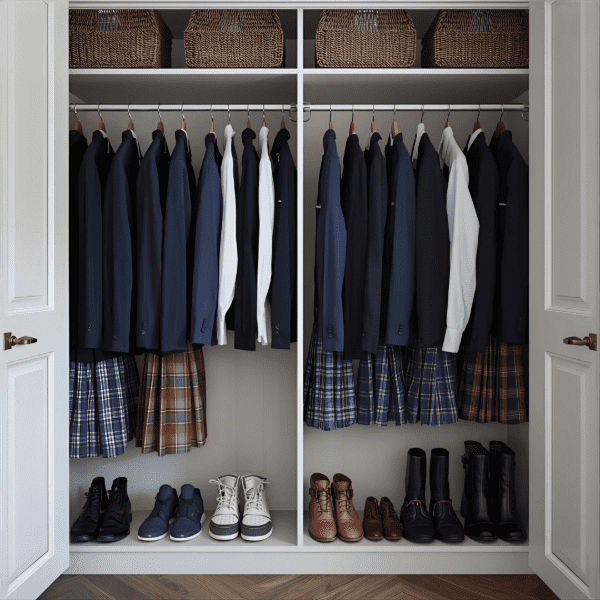
Organized school uniform wardrobe with multiple uniforms arranged by type
Browse Our Complete School Uniform Collection
Kindergarten and Montessori environments approach clothing requirements differently from traditional primary schools.
South African nurseries often require uniforms similar to those of primary school but with greater emphasis on comfort and practicality. Some schools keep it simple, just requesting clothing in specific colors rather than branded items. Budget R500-R1,200 for a complete pre-school wardrobe.
Montessori schools often take an even more relaxed approach. Clothing must allow for freedom of movement, support independence, feature neutral colours, and prioritise function over decoration.
Safety remains paramount – avoid drawstrings, choose flame-resistant fabrics where possible, ensure proper shoe fit, and select fabrics that allow for temperature regulation.
Explore Our Nursery School Uniform Options
Primary school uniforms in South Africa generally follow a standard template, though specific requirements vary by institution.
For Boys (Grade R-7): Short or long trousers, shirt, jersey and/or blazer, tie (if required), belt, school shoes, socks, sports kit, and sun hat.
For Girls (Grade R-7): Skirt, pinafore, or culottes, blouse, jersey and/or blazer, tie or ribbon, tights or socks, school shoes, sports kit, sun hat, and hair accessories in school colours.
Grade R-2: Prioritise comfort and ease. Young ones need uniforms that they can manage independently-elastic-waist options triumph over complicated buttons. Velcro shoes outperform laces.
Grade 3-5: Durable fabrics that withstand playground adventures while maintaining a neat appearance become crucial. Stain-resistant treatments prove worthwhile.
Grade 6-7: Pre-teens become more conscious of appearance. Proper sizing matters increasingly. These years typically see children through significant growth spurts.
Explore Our Primary School Uniform Options
The transition to high school introduces new uniform requirements and heightened awareness in students about the importance of fit and appearance.
High schools maintain formal standards while introducing more complex requirements. Boys typically need long trousers, formal shirts, ties, jerseys, blazers, and extensive sports kits. Girls require skirts or culottes with specific length requirements, formal blouses, ties, jerseys, blazers, and comprehensive sports gear.
High school sports requirements often multiply beyond primary school basics. Depending on your child's activities, you may need multiple sports shirts for different codes, a specific kit for various sports, swimming costumes in school colours, and protective gear. Budget accordingly – a sporty child might require from R1,500 to R2,500 in sports kit alone.
Teenagers are acutely conscious of appearance. While primary school children tolerate "room to grow," high school students strongly prefer uniforms that are properly fitted. This creates a budgeting challenge during periods of rapid growth. Consider purchasing mid-range quantities initially, then replacing items as your teen grows, rather than buying oversized uniforms they'll refuse to wear.

High school students in sports uniforms during a competitive inter-school match
Explore Our High School Uniform Options
Boarding school uniform requirements operate on an entirely different scale. You're packing for a child living away from home, potentially for an entire term.
A day school child might manage with three shirts; a boarding school student needs at least six. Limited laundry access, the need for complete changes after sports, and the reality that boarding school life is harder on clothes necessitate doubling everything.
Comprehensive Boarding School List
Private school uniforms typically cost 40-60% more than public school equivalents, with some matric-specific items (jackets, special ties) adding R1,000-R1,500 to the total.
Start with essentials rather than purchasing maximum quantities immediately—three shirts, two bottoms, one jersey, and one sports kit will get you through the first term while you assess actual wear patterns and growth rates
Stagger purchases throughout the year if the budget allows, buy summer uniforms in November-December and winter items in May-June to spread costs and ensure appropriate sizing for each season.
Factor in hidden costs beyond the uniforms themselves: name labels, shoe polish, laundry supplies, and inevitable replacements when items go missing
Quality proves a worthwhile investment. Well-made uniforms from high-quality fabrics genuinely last longer; a R180 shirt that survives the entire year proves more economical than an R90 shirt that needs to be replaced after one term.
This question plagues parents annually, and the answer depends on your child’s washing frequency and the type of school they attend.